Cosmic visions. Utopias in public spaces
Lithuanian utopian visions in public spaces are represented here by two figures: the stained glass artist Algimantas Stoškus (1925–98) and the sculptor Teodoras Kazimieras Valaitis (1934–74). In the 1960s and 70s, Lithuanian public interior spaces were invigorated by various modernist projects. These were partially motivated by a requirement that one to three per cent of the overall budget be spent on the creation of unique art and design objects.
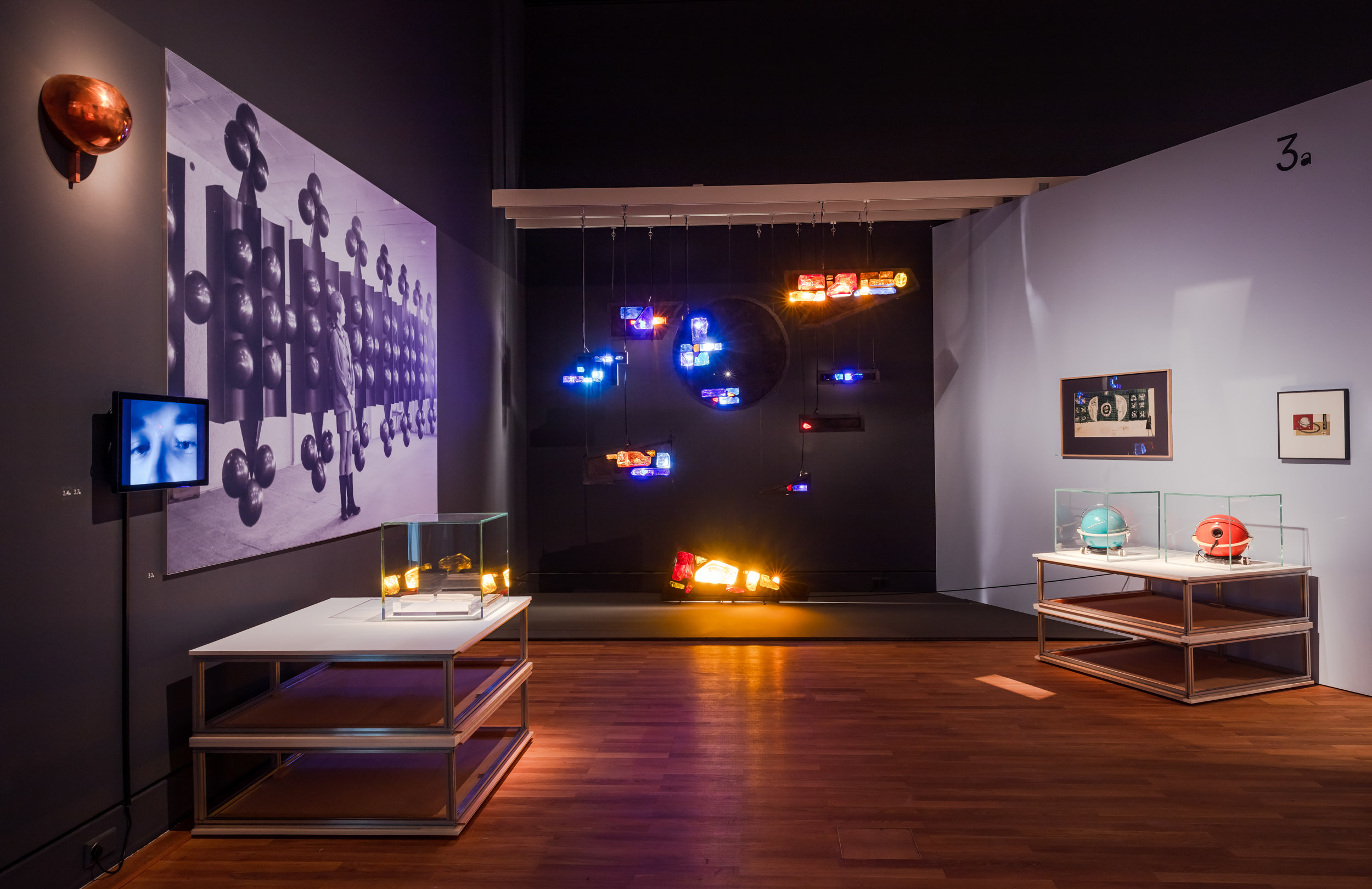
Stoškus’ Cosmic Fantasy (1965) addressed one of the main themes of Soviet propaganda: the conquest of space. This paean to Soviet ideals allowed him to create an abstract composition that answered the problem of how to arrange stained glass within an undefined architectural space. Stoškus was one of the first artists in Lithuania to use thick glass. He was inspired by the famous Czech glass artists Stanislav Libenský and Jaroslava Brychtová, whom he had met in 1957. It was at the Neman glass factory in Belarus that he mastered new techniques and did his experiments with slab glass.
Active in the 1960s and 70s, Valaitis was a visionary Lithuanian sculptor whose sketches and metal decorative compositions were contemplations of space and sky, endless perspectives in which lines intersect from the past and future, from dreams and fantasies. Valaitis created two decorative partitions for Žirmūnai, a restaurant in Vilnius (1969). Here, he integrated the metal hulls of the Saturnas, a popular Lithuanian vacuum cleaner, making their circular shapes an essential visual element.
In 1966, Valaitis was invited to show a decorative panel at the Leipzig Spring Fair. Projects by Stoškus and Valaitis were part of the USSR pavilion at both Expo ’67 and Expo ’70 (although the biomorphic wall planned by Valaitis for the 1970 Osaka Expo remained unimplemented). Stoškus’ contribution to the Lithuanian section of the 1968 Soviet Union Industry and Trade Exhibition in London, an eight-meter-high kinetic stained-glass piece entitled Vilnius: The Capital of Lithuania (not preserved), can be considered one of the most utopian design projects realized at the time.
Countries: Lithuania
Tags: Applied art, Architecture, Material, Urban design